
Tabebuia is a genus that used to contain several "Guayacán" species. Guayacán trees are typical of tropical dry forests, where the ESPOL campus is located. Each year, following the first rains of the rainy season, guayacán trees fill the landscape with bright live yellow flowers breaking the somewhat monotonous tan shades typical of the dry season in a striking natural spectacle. Aside from this natural show, in the tropics guayacán trees (now in the genus Handroanthus1) are valued for the quality and strength of their wood and for their adaptation to harsh growing conditions. For these reasons, throughout history different groups, communities and even entire countries2 have chosen the guayacán as a symbol that represents them, as we just did in this website.
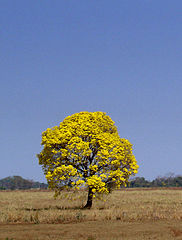 Photo: Leonardo "Leguas" Carvalho/Wikimedia commons
- Grose, S.O. and R.G. Olmstead. 2007. Taxonomic Revisions in the Polyphyletic Genus Tabebuia s.l. (Bignoniaceae). Systematic Botany 32(3):660-670.
- A.H. Gentry. 1992. A Synopsis of Bignoniaceae Ethnobotany and Economic Botany. Annals of the Missouri Botanical Garden 79(1):53-64.